
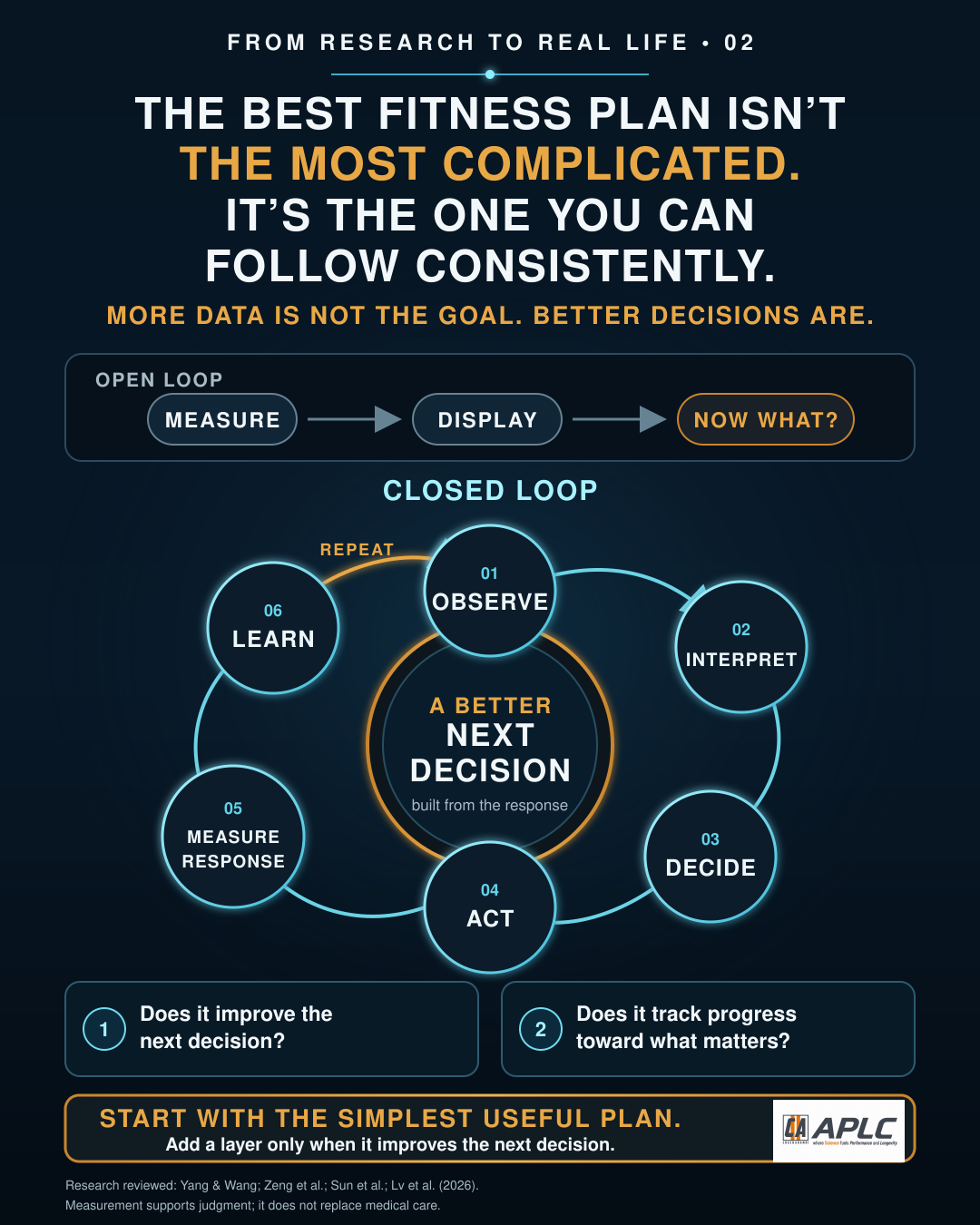
More data is not the goal. Better decisions are. Start with the simplest useful plan, learn from the response, and add another layer only when it improves the next decision.
We can measure more about our bodies than ever before. A watch can estimate sleep, heart-rate variability, resting heart rate, activity, recovery, and readiness. An app can turn those measurements into scores and graphs. BMI, lab results, strength tests, and other assessments can add even more numbers. But as people get older—or begin living with a condition that affects their physical capacity—collecting more information is not enough. We need to ask two questions: Does the information help us make a better decision? And does that decision help the person move toward a goal that truly matters to them?
BMI and other health measures can provide useful context, but they cannot tell us whether someone is getting better at hiking, whether they can keep up with their spouse, or whether they are becoming more capable while living with a condition that affects their movement. The fear behind many questions about aging and longevity is rarely about a number. People are afraid of losing the ability to hike, ride, travel, play with their grandchildren, share an active life with someone they love, or remain independent in their own home. They also fear that the years they imagined spending with family, traveling, creating, exploring, or enjoying retirement may instead include more time in doctors’ offices and hospitals, taking medications, and undergoing tests. Appropriate medical care, testing, and medication can protect health and should not be dismissed. But they should support a person’s life, not become the center of it. A declining score may get someone’s attention, but losing time, freedom, health, and access to the life they expected is often the greater concern. Recent research helps explain why measurement alone is not enough—and why the simplest useful system is often the best place to start.
The research: collecting data is only the beginning
A 2026 review by Yang and Wang looked at wearables and artificial intelligence used to help people with several long-term health conditions become more active. The tools were best at helping people track their behavior and, in some cases, move more. The research was much less clear about whether these tools improve long-term health by themselves, and the research on AI was still early. The authors said these tools are most useful when they are part of a closed loop: the device gathers information, someone makes sense of it, the plan changes when needed, and the person’s response guides the next decision. The research does not show that a watch, an algorithm, or a readiness score automatically makes someone healthier. The information becomes useful when it helps create an action and when we learn from what happens next.
A second 2026 review by Zeng and colleagues helps show what can happen when that support is missing. The researchers looked at 17 controlled studies involving 8,990 adults who used digital programs to become more active. The average improvement was small when the programs ended. At the longest follow-up, there was no clear lasting improvement, and the researchers had low confidence in the long-term evidence. This does not mean apps and wearables are useless. It means we should not expect a score, graph, or reminder to create lasting change on its own. A device may provide the signal, but someone still has to turn that signal into a decision the person can understand and follow.
A review by Sun and colleagues looked at 11 studies of wearables used by people with type 2 diabetes. The researchers found six common ways the devices might help: tracking behavior, giving quick feedback, setting goals, building motivation, providing support, and helping people feel more confident. The studies were small and very different from one another, so the review could not prove that these six things caused better results. It did show that the device was more useful when its information was tied to feedback, goals, support, and action.
Finally, a 2026 paper by Lv and colleagues described movement data from 120 people in a two-week stroke rehabilitation program. The program used the same movement tests at the beginning and end. This gave the team a way to compare each person's movement over time and choose training movements that fit the person's needs. This study involved people recovering from strokes, not people with CMT or the general public, and it did not prove that the same system will improve results for everyone. But it gives us a clear example of why a test should be repeatable. When we measure something the same way over time, we have a better chance of seeing whether the person is changing.
The simplest useful loop
Taken together, these papers support a straightforward model:
Observe → Interpret → Decide → Act → Measure the response → Learn → Repeat
Most systems begin with the first step and stop too early. They observe sleep, heart rate, steps, or movement and display the result. The person is then left to decide what the number means and what to do about it. I prefer to begin with the minimum information needed to make a responsible decision. That may include a few objective measurements, the person's recent training, and simple questions about sleep, energy, soreness, pain, and how they responded to the previous session. If another measurement will meaningfully improve the next decision, we can add it. If it only creates more information to look at, it has not earned a place in the system yet. The goal is not to build the most complicated plan. The goal is to make the next appropriate decision, see what happens, and make the following decision a little better.
Steve’s goal was in Sedona

Meaningful progress is preserving the strength, confidence, and independence to keep participating in your own life.
This is where both questions connect to Steve. Was the information helping us make better training decisions? And were those decisions helping him become a better hiker and remain stronger, steadier, and more capable while living with CMT? Steve has Charcot-Marie-Tooth disease, or CMT. It is an inherited condition that damages the nerves outside the brain and spinal cord. Those nerves carry messages between the brain, muscles, feet, and legs. As CMT progresses, those messages can become weaker. This can lead to muscle weakness, loss of feeling, poor foot control, balance problems, and less endurance. There is currently no cure. Exercise does not repair the damaged nerves or treat CMT itself, but building and preserving strength, balance, mobility, and conditioning can still help Steve protect his function and do more of what matters to him.
This is the third chapter of Steve's story. In From Bill to Steve, and What Comes Next, I introduced Steve, CMT, and our goal of helping him prepare for demanding travel. In What Longevity Looks Like When It Matters, we saw what happened after a focused six-week training block. During his trip through Spain and Morocco, Steve regularly passed 10,000 steps. At the Alhambra, he reached about 16,000 steps while handling steep hills, stairs, long walks, and uneven ground. His trekking poles went from feeling necessary to becoming more optional as the trip continued. Those achievements did not make CMT disappear. They showed that Steve could build useful capacity even while living with a condition that makes walking, balance, and endurance harder.
When Steve and I began working together, he had recently been walking with a cane. One of his meaningful goals was to return to Sedona and hike with his wife. This was not just a fitness target. Sedona had become part of their family’s future: a place where they hope to return every year with their children and grandchildren. His wife is more physically active and had often needed to hike without him. For Steve, being able to go with her meant participating in a part of their life together that mattered to both of them. We had a relatively short preparation period, but Steve felt ready for the trip. He completed the hikes he wanted to do and spent that time outside with his wife. He described the trip and the training that prepared him for it as a success, but the story did not end when the hike ended.
Steve and his wife walked or hiked every day. Although his leg and knee did not initially feel seriously irritated, the accumulated activity eventually proved to be more than the leg was ready to tolerate. Steve described one of the central challenges this way:
“I think I’m fine, and then I’m not.”
He finds it difficult to recognize the point where he crosses from doing well into having done too much. He still remembers how far and how fast he used to be able to go, and accepting that his current limits may be different is not only a physical adjustment. It is a mental one. From my coaching perspective, the response after the hikes gave us useful information about Steve's present capacity. That is an interpretation—not proof that one specific activity caused the irritation or that CMT was the only factor. It tells us that completing one hike successfully did not necessarily mean his leg was ready for several consecutive days of similar loading without more recovery. Steve drew his own practical lesson from the experience: if he is preparing for another demanding trip, he may need a longer lead time. He may also need to stop before he wants to, rather than waiting until his body makes the decision for him. That is not a failed plan. It is the next turn of the loop.
What counts as a meaningful assessment?
An objective assessment should be repeatable, but it should also connect to the person’s actual goal. For a cyclist, functional threshold power may be an important measure. For Steve, the meaningful question is different: Is he building enough capacity to hike with his wife, and can he recover well enough to do it again without creating a problem that follows him home? We can still use conventional measurements of strength, balance, mobility, walking, and conditioning. We can also look at how his leg responds during the activity, later that day, and the following morning. The important part is using similar questions and repeatable assessments over time so that we are not relying only on memory or on how he feels in one moment.
Simple morning questions can help identify whether the previous day's activity is still affecting him. A repeatable walking or movement assessment can show whether his capacity is changing. His training can then be progressed, maintained, or reduced according to the complete picture rather than one isolated score. This does not produce perfect certainty. Steve's condition makes that unrealistic, and human bodies do not always respond on schedule. What it can provide is a more disciplined way to learn from what happened instead of repeating the same mistake or becoming afraid to try again.
The real intervention is the learning
At Steve’s retirement party, his older brother and sister told me how happy they were to see their little brother walking without a cane. His wife also expressed what it meant to have him hiking with her again. Those conversations mattered to me because they reflected the outcome that no readiness score could fully represent. The measurable result was not simply that Steve walked farther or completed a workout. It was that he could share a meaningful experience with his wife in a place they hope will remain part of their family’s life for years.
The trip also reminded us that success is not the same as certainty. Aging, chronic conditions, previous injuries, and changing capacity can make it harder to know exactly how much is enough. That uncertainty can be frightening, especially when people wonder whether each setback signals a further loss of independence—or more time organized around appointments, tests, medications, and recovery instead of the people and experiences they value. But an imperfect response does not have to mean inevitable decline, and it does not make the original effort meaningless. It can become useful information when someone is paying attention, interpreting it carefully, and changing the plan.
The answer is not to avoid doctors, medications, or tests when they are needed. It is to use medical information, assessments, training, and daily feedback together to protect as much health and physical capacity as possible—and to keep the person’s real life at the center of every decision. The wearable is not the intervention. The assessment is not the intervention. Even the individual workout is not the whole intervention. The intervention is the continuing process that connects all of them: observe, interpret, decide, act, measure the response, learn, and repeat.
The simplest useful version of that loop should come first. We add layers only when they help us make the next decision better. The real goal is not to build the most advanced system or produce the best-looking score. It is to preserve more independence, keep more time outside the medical system when possible, and continue participating in the life that all of those scores, tests, and treatments are supposed to support.
Sources
Yang L, Wang X. “Digital health solutions for chronic disease physical activity management: wearable devices, artificial intelligence, and public health implementation.” Frontiers in Public Health. 2026. https://doi.org/10.3389/fpubh.2026.1888001
Zeng J, Li H, Zhang X. “Post-intervention durability of standalone digital behavior change interventions for physical activity in adults: a focused mini review and quantitative synthesis.” Frontiers in Public Health. 2026. https://doi.org/10.3389/fpubh.2026.1878053
Sun W, Xie D, Hou W, et al. “Behavior change pathways by which digital wearable devices support exercise self-management in type 2 diabetes: a scoping review with machine learning-assisted text mining.” Frontiers in Public Health. 2026. https://doi.org/10.3389/fpubh.2026.1871682
Lv M, Gao Y, Cheng G, et al. “A wearable sensor-based kinematic dataset collected under standardized rehabilitation tasks from 120 post-stroke patients.” Scientific Data. 2026;13:1136. https://doi.org/10.1038/s41597-026-07802-2
National Institute of Neurological Disorders and Stroke. “Charcot-Marie-Tooth Disease.” https://www.ninds.nih.gov/health-information/disorders/charcot-marie-tooth-disease