
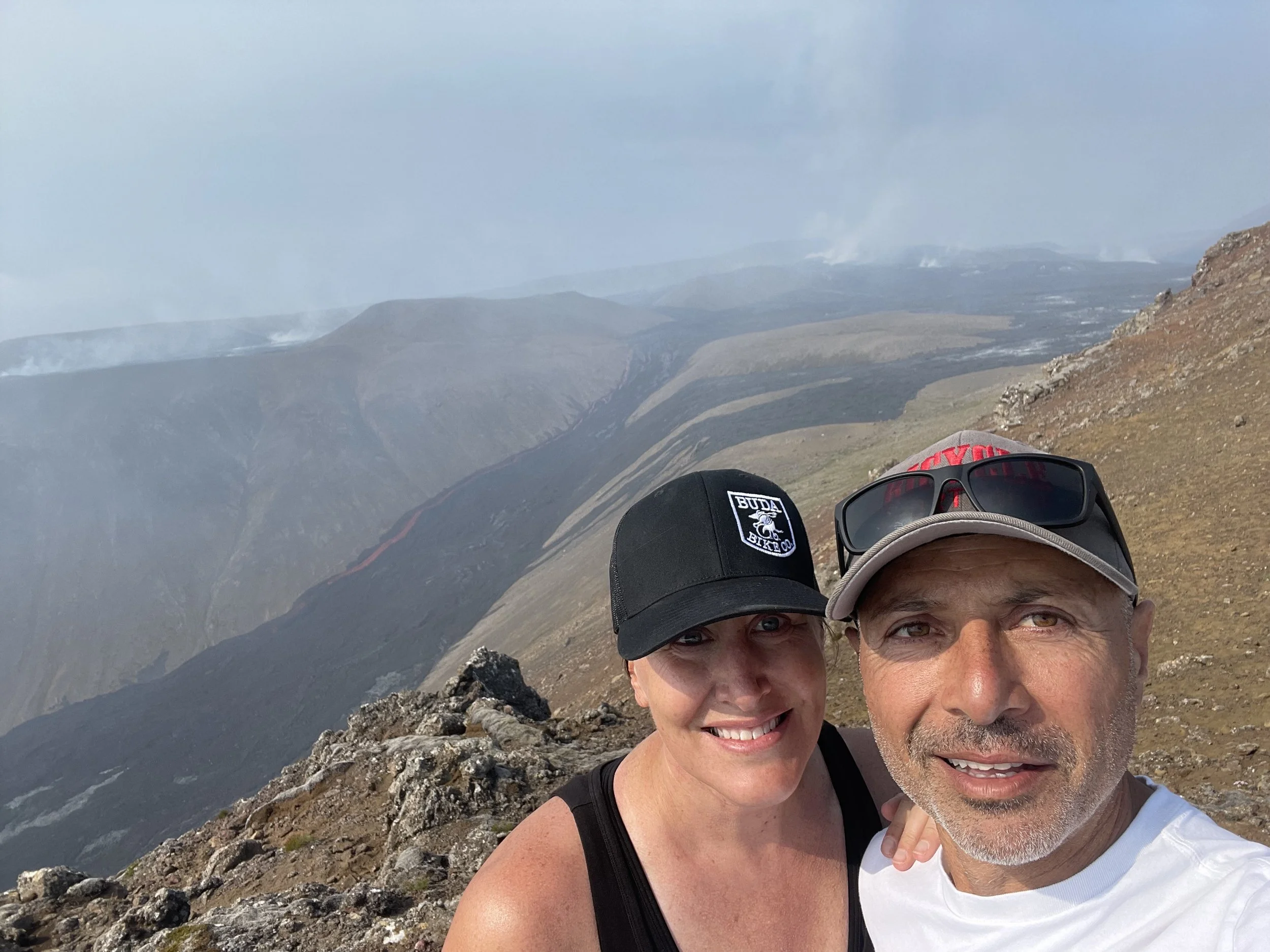
For me, longevity is not an abstract number. It is the physical reserve to keep traveling, exploring, and sharing demanding experiences with the people who matter.
I am genuinely excited to bring you a new blog series called From Research to Real Life. It grew out of questions I am often asked by friends, family, and clients: “Hey, I just read this research—what does it mean?” “Do you think this could help me?” “How should I use it?” I will also examine wearable devices and other health products, including fitness trackers, smartwatches, home-monitoring tools, recovery technologies, and wellness products that claim to improve health, performance, or longevity. The goal is not simply to repeat what a product promises, but to look at what it actually measures, how reliable and useful that information may be, who might benefit, and how it could—or could not—fit into an individualized plan.
Those conversations are why I decided to turn this into a series instead of continuing to answer these questions randomly. Each time, I will take current research in health, performance, or longevity, explain what it actually found, and explore what it may mean for me, for you, and for people with different health histories and goals. I will also examine products, technology, and gadgets that claim to support a healthy, active life. If there is something you want me to investigate, suggest it in the comments and give me some context: why it matters to you, what you hope to learn, or what decision you are trying to make. That context is what allows me to move beyond simply explaining the information and start exploring how it could be used in real life.
For the first article, I want to ask something that is rarely answered during a typical medical appointment: What if your laboratory results look reassuring while the physical abilities that protect your independence are quietly declining?
Many people know the frustration of asking how they can protect their long-term health and being told that their numbers are acceptable, their medication is working, or they should return if something gets worse. The physician may be appropriately managing the medical risks in front of them, and the testing may be doing exactly what it was designed to do, but it often does not measure whether someone can regain balance after a stumble, rise easily from a chair, carry luggage through an airport, climb stairs without exhaustion, or identify strength, balance, mobility, vision, home-environment, and medication-related risks that could lead to a fall before one occurs—a fall that can greatly limit independence. Medical care often becomes most active after a diagnosable problem or significant symptom appears.
That leaves an important gap for people who do not want to react to health problems but want to make better choices now to hopefully avoid them altogether and preserve the ability to travel, work, play, explore, help their family, and continue living on their own terms. They want to preserve their active lifestyle well into retirement and older age rather than spend their time and money going to doctor appointments and having to take a handful of pills every day whose side effects are often worse than what they are trying to “fix.” What are the side effects of better lifestyle choices?
What the Research Found
A new JAMA Network Open study helps explain why that gap matters. Researchers studied 13,423 community-dwelling adults aged 65 or older in Taiwan and followed them for a median of seven years. Instead of relying only on diagnoses or asking whether participants exercised, they objectively measured four areas of physical fitness: cardiorespiratory fitness, upper- and lower-body strength, flexibility, and balance and agility. The seven assessments included a 2-minute step test, chair stands, arm curls, two flexibility tests, a one-leg stance, and an 8-foot up-and-go test.
Better performance was associated with lower all-cause mortality across every assessment. The strongest individual associations involved the 8-foot up-and-go, one-leg stance, chair stand, and 2-minute step test, while the combined multidomain fitness score showed the strongest overall association. Importantly, these relationships remained after the researchers adjusted for age, medical history, body mass index, socioeconomic factors, and whether participants reported meeting regular physical-activity guidelines.
This was a large and valuable observational study, but it was not an exercise intervention. It cannot prove that improving one test result will make someone live longer. Fitness was measured only once, participants had to be healthy and mobile enough to complete the assessments, important factors such as smoking were not measured, and the findings may not apply equally to every population. The study also did not directly prove that physical-fitness testing predicts risk better than established medical models. What it showed is that objective physical capability contains meaningful information that diagnoses, disease lists, and self-reported exercise do not fully capture.
What That Means in Real Life
In practical terms, the study is not telling everyone to train for a chair-stand test. It is showing that there is a difference between saying you are active and demonstrating what your body can actually do. Someone may walk regularly but have poor balance. Another person may be strong but have very little aerobic reserve. Someone else may perform well on a bike or rowing machine while struggling with stairs, standing, or walking. A single result can identify one useful piece of the picture, but the combined fitness score was more strongly associated with mortality than any individual test. That supports looking across several physical capacities rather than allowing one strength—or one diagnosis—to define the whole person.
This is also where population research has to become individual planning. The study can point toward capacities that may matter, but it cannot tell me which one is limiting the person in front of me, what is safe to challenge, what needs medical collaboration, or what that person wants their body to remain capable of doing. That is why I always begin new client assessments with questions rather than tests. I want to understand what is important and meaningful to you: What do you want to keep doing? What activities, responsibilities, or experiences are you worried about losing? What does a good day look like, and what currently gets in the way? What is your medical history, what symptoms have you noticed, how do you recover, and what have you already tried? Those answers determine what we need to measure.
From there, I use carefully chosen mobility and functional tests that relate to your goals and circumstances. The assessment may examine balance, strength, movement control, walking tolerance, getting up and down, or the specific physical demands of work, travel, sport, or daily life. Finally, I usually include a submaximal cardiovascular assessment to understand how your body responds to an appropriate level of exertion. Most people do not need to begin with a VO2 max test unless that information is specifically relevant to their goals, sport, medical situation, or the decisions we are trying to make. The purpose is not to collect the most impressive amount of data. It is to gather the right information safely and usefully, then connect it to a plan that fits the individual.
One Case: Applying the Research to an Individual Plan
One person I work with has significant knee degeneration but wants to continue playing golf, traveling, and taking part in demanding outdoor activities. The diagnosis helped explain the condition of the knee, but it did not tell me how long this person could walk before symptoms began, how prolonged sitting affected the following day, how much lower-body strength remained, or which forms of cardiovascular exercise could be performed successfully. Those were the limitations of relying on the medical record alone.
I began by discussing what this person wanted to remain capable of doing and what activities were becoming more difficult, then collected information through a combination of history, symptom and activity tracking, movement and functional assessments, strength testing, and a submaximal cardiovascular assessment. The research used a broad set of physical capacities—cardiorespiratory fitness, strength, flexibility, balance, and agility—to show why a diagnosis or self-reported activity level may not provide a complete picture, which provided the framework for deciding which capacities were most relevant to this person’s goals and limitations.
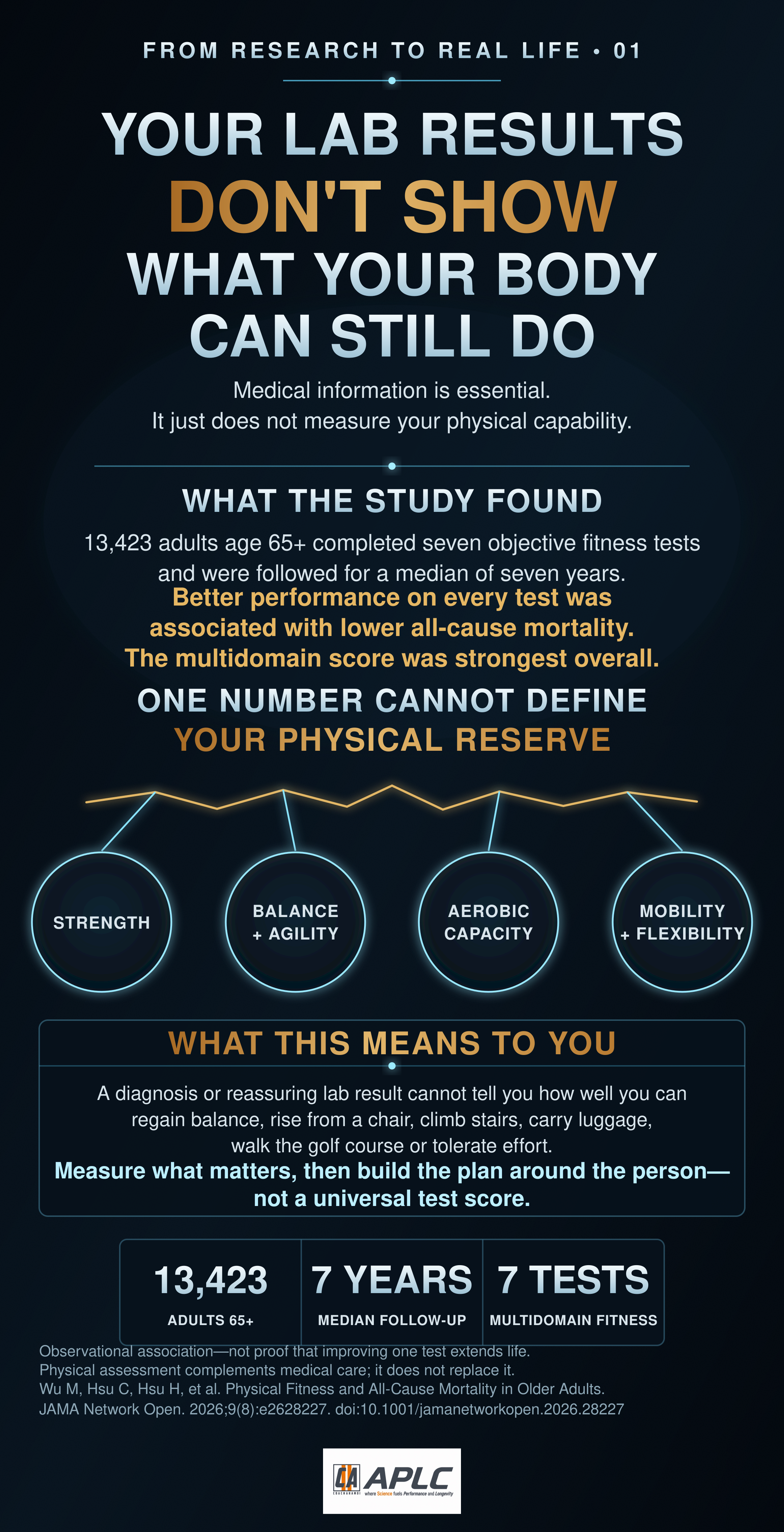
In a 2026 observational study of 13,423 adults aged 65 or older, better performance across seven fitness assessments was associated with lower all-cause mortality, and the combined multidomain score showed the strongest overall association. The study does not prove that improving one test extends life.
The assessment showed reduced tolerance for continuous walking and some movement demands, but it also revealed meaningful remaining strength and the ability to use other forms of cardiovascular training. That distinction was important. If the focus was only on the knee diagnosis or on pain during walking, the plan might have become overly protective and reduced activity further, and if the focus was only on the person’s desire to remain active, we might have progressed too aggressively. Instead, the findings helped identify what could be trained, what needed to be modified, and what required closer monitoring.
The research therefore informed the structure of the plan. Lower-body strength, balance and agility, aerobic fitness, and the interaction among these capacities became priorities because they were relevant both to the study and to the person’s real-life goals. The plan included progressive strength training, improved whole-body movement and control, cardiovascular training through tolerable methods, and gradual exposure to the walking and rotational demands of golf. Travel and extended sitting were included because they were part of this person’s life, not because they were variables in the study.
Ongoing feedback was essential. We monitored symptoms, walking tolerance, recovery, response to cardiovascular exercise, and the person’s ability to participate in golf and travel-related activities. The plan could then be adjusted as the person demonstrated greater capacity or showed signs that a demand was too high. The goal was not to produce a perfect knee or an impressive score on one test. It was to build enough physical reserve to travel, play golf, and remain active without every demanding experience creating a setback.
What You Can Do With This Information
Taking greater control of your long-term health does not mean rejecting medical care or trying to interpret every research paper yourself. It means asking questions that may not be answered by your routine medical results. What can you do now? Which physical capacity is beginning to limit you? What do you want to remain capable of doing five, ten, or twenty years from now? Are you measuring the areas that matter to those goals, and are you reassessing them often enough to know whether your plan is working?
A useful starting point is an objective baseline across several relevant areas—strength, balance and movement, aerobic capacity, and mobility—interpreted alongside your medical history, current symptoms, goals, and daily life. The answer should not be a universal pass-or-fail score. It should help identify what remains strong, what may be quietly declining, what deserves attention first, and whether the work you are doing is producing a meaningful change. When an assessment reveals a concerning response, taking control may mean involving a physician, therapist, or another professional before progressing. When it reveals a trainable limitation, it gives you an opportunity to act before that limitation becomes a major loss of independence or capability.
What area of health, longevity, or performance research—or what product or technology—would you like me to examine next?
Research
Wu M, Hsu C, Hsu H, et al. Physical Fitness and All-Cause Mortality in Older Adults. JAMA Network Open. 2026;9(8):e2628227. doi:10.1001/jamanetworkopen.2026.28227.
https://jamanetwork.com/journals/jamanetworkopen/fullarticle/2852597