
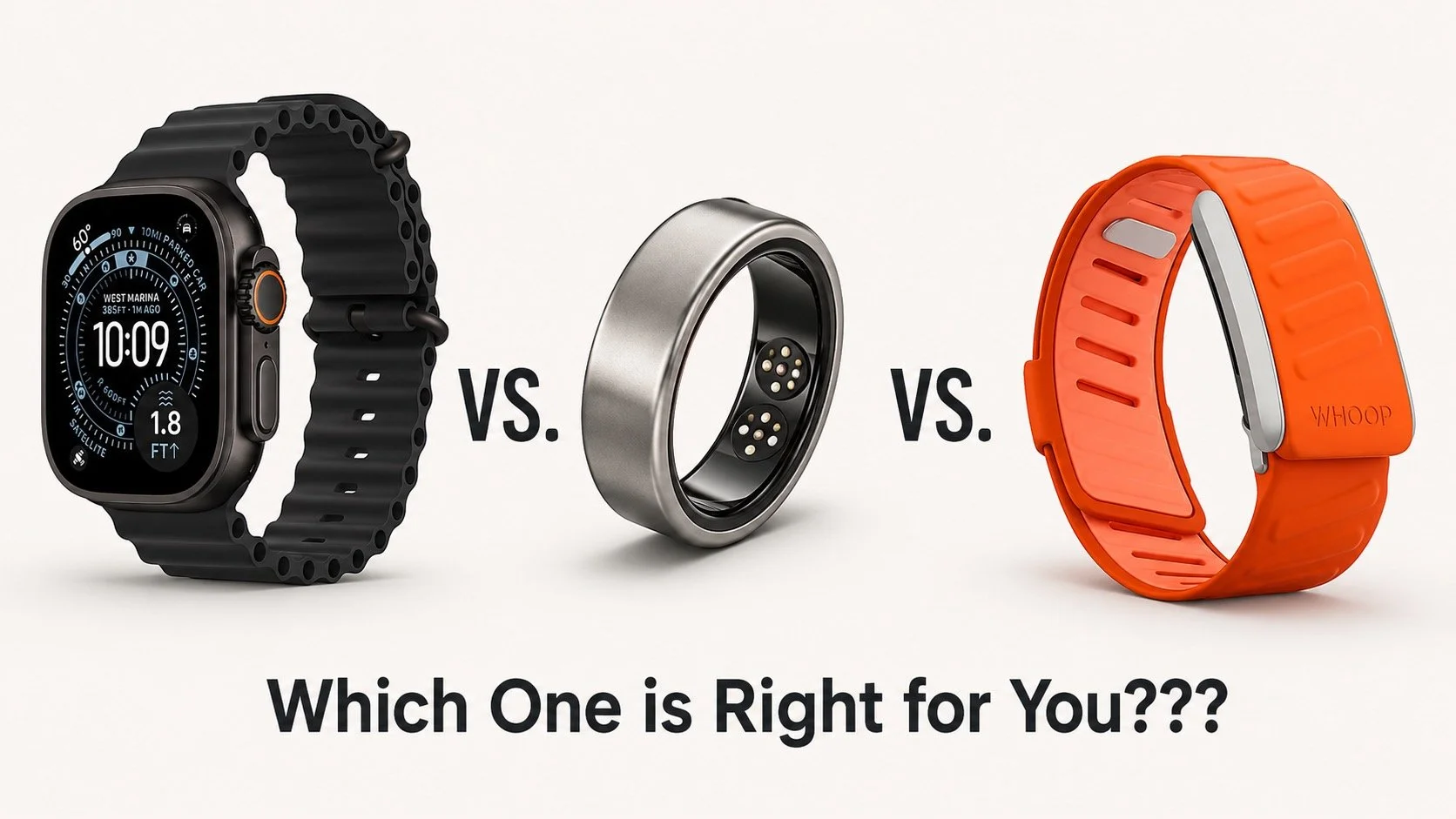
This is not a tech review. There are plenty of those already for Apple Watch, Oura Ring, and Whoop.
This is my opinion after almost two decades of using wearables for myself and watching how clients respond to them in real training, health, performance, recovery, and longevity plans, and in my observations the real question is not which wearable is the best. The better question is which wearable gives the right person the right kind of feedback, in a way they will actually use.
In my years as a coach and trainer, I have seen two almost equally emerging groups. One group wants a wearable that gives them loads of data on a screen. The other group wants the data without having another screen in their face all day. Both can be right. It depends on the person, their goals, their activities, and how the information is going to be used.
I am clearly in the “must have a screen” group. The super obvious tan line on my left wrist from the Apple Watch Ultra 3 that is usually hugging it, and by all of its predecessors before it, gives that away pretty quickly. I like live data. I like being able to control intensity during a workout by seeing heart rate, pace, distance, zones, and other information while I am doing the workout. For running, biking, hiking, and outdoor training, that matters to me.
The other part for me is safety and minimalism. I would rather not take my phone along for a mountain bike ride, run, short hike, or any kind of activities with water if I do not need to. Being able to reach out if something happens, or have a family member reach me, matters. Features like fall detection, Emergency SOS, location sharing, and satellite communication on newer Apple Watch Ultra models are not small things if you spend time outside. Apple Support
But not everyone wants that. The “I don’t need it in my face” group tends to value having some breaks from being connected. Many of them are also better at self-adjusting effort during workouts. For them, the wearable data is less about controlling the workout live and more about looking at recovery, sleep, strain, stress, and long-term trends.
That is where Oura and Whoop make a lot of sense.
Oura Ring shines with sleep and recovery data, partly because of where the sensor sits. The finger is a strong place to collect pulse signals, and Oura focuses heavily on sleep, HRV, resting heart rate, temperature trends, and personal baselines over time. Oura Readiness Score. But the ring also has an obvious limitation: it does not work well for every activity. If you rock climb, do heavy barbell lifts, pull-ups, kettlebells, or other training where a ring gets in the way or creates risk, then Oura may be great overnight but not ideal as your workout wearable.
That is where Whoop often fits better. For people who want similar recovery, sleep, strain, and readiness-style data but do activities where wearing a ring does not make sense, Whoop is usually the more practical no-screen option. It is built more around sleep, strain, recovery, stress, heart-rate zones, and coaching-style feedback without needing a watch screen. Whoop recovery, sleep, and strain
Another trend I have noticed is that the right wearable also depends on whether the person’s plan is mostly focused on longevity, or whether performance in certain activities is also a major goal. Everyone has their own goals, and what you choose to help you reach them can have a real impact on how well the plan works. If the goal is mostly long-term health, sleep, recovery, resting heart rate, HRV, stress, and consistency may be the most valuable signals. If the goal is longevity plus performance in running, cycling, climbing, strength training, or hiking, then live workout data, GPS, pace, elevation, heart-rate zones, and safety features may matter a lot more.
This is also where the bigger point comes in. The wearable is not the plan.
A wearable can collect information, but the real value is how that information is used. It is not only about how I feel today or what level of performance I am at now. It is also about what I want my body to be capable of in my 40s, 50s, 60s, 70s, and beyond, and how the plan should shift over time to prepare for that. A generic plan using generic logic will always be limited compared with a deeply researched and personalized approach that fits the person’s lifestyle, goals, training history, and future needs. That approach also has to keep getting smarter by learning from the client, and make the right tweaks.
That matters because daily behavior is one of the biggest levers we have. Research available through the National Library of Medicine has commonly estimated that genetics account for only part of human longevity, with one review noting that genetic factors explain about 25% of variation in longevity. Newer research on lifestyle and epigenetics also shows that diet, exercise, mindfulness, sleep quality, stress, and environment can influence mechanisms such as DNA methylation, which affect how genes are expressed over time. National Library of Medicine longevity review National Library of Medicine lifestyle and epigenetics review
So the habits your wearable helps you notice can matter far beyond today’s workout. Sleep, recovery, movement, intensity, stress, and consistency add up. Short-term data can help guide today’s decisions. Long-term data can help reveal patterns that may shape how you train, recover, and prepare for the challenges that happen to most of us later in life.
If you want live data, outdoor safety, workout control, and Apple Health integration, Apple Watch Ultra is hard to beat.
If you want sleep and recovery trends with less screen exposure, and your activities allow you to wear a ring safely, Oura can be a great fit.
If you want recovery, sleep, strain, and training-load feedback without a screen, and you do activities where a ring does not work, Whoop may make more sense.
In my humble opinion, after almost two decades of using wearables for myself and with clients, the wearable has to be based on your goals, not the other way around.
The right wearable is not the one with the most features. It is the one you will actually wear, understand, and use in a way that supports your health, your performance, and your long-term plan.