
Bridging the Gap: What Current Research Means for Your Longevity Plan
Health and longevity research is getting closer and closer to the point where exercise, nutrition, sleep, recovery, and lifestyle changes can be applied almost like a prescription. Not in the sense that they replace medical care, and not in the sense that everyone should follow the same exact formula, but in the sense that research is starting to show us more clearly which tools can help, what kind of dose may matter, and how specific changes can influence long-term health. That is exciting to me, but it is also where the real work begins, because research does not become useful just because it exists.
Research becomes useful when it is applied to the person in front of me.
That means the right dose, the right format, the right timing, the right progression, and the right fit for that person’s life. It also means tracking whether the plan is actually working, because the goal is not to sound smart or use the newest study as a talking point. The goal is to create measurable change in someone’s health, performance, confidence, and long-term direction.
That is what I mean by Bridging the Gap.
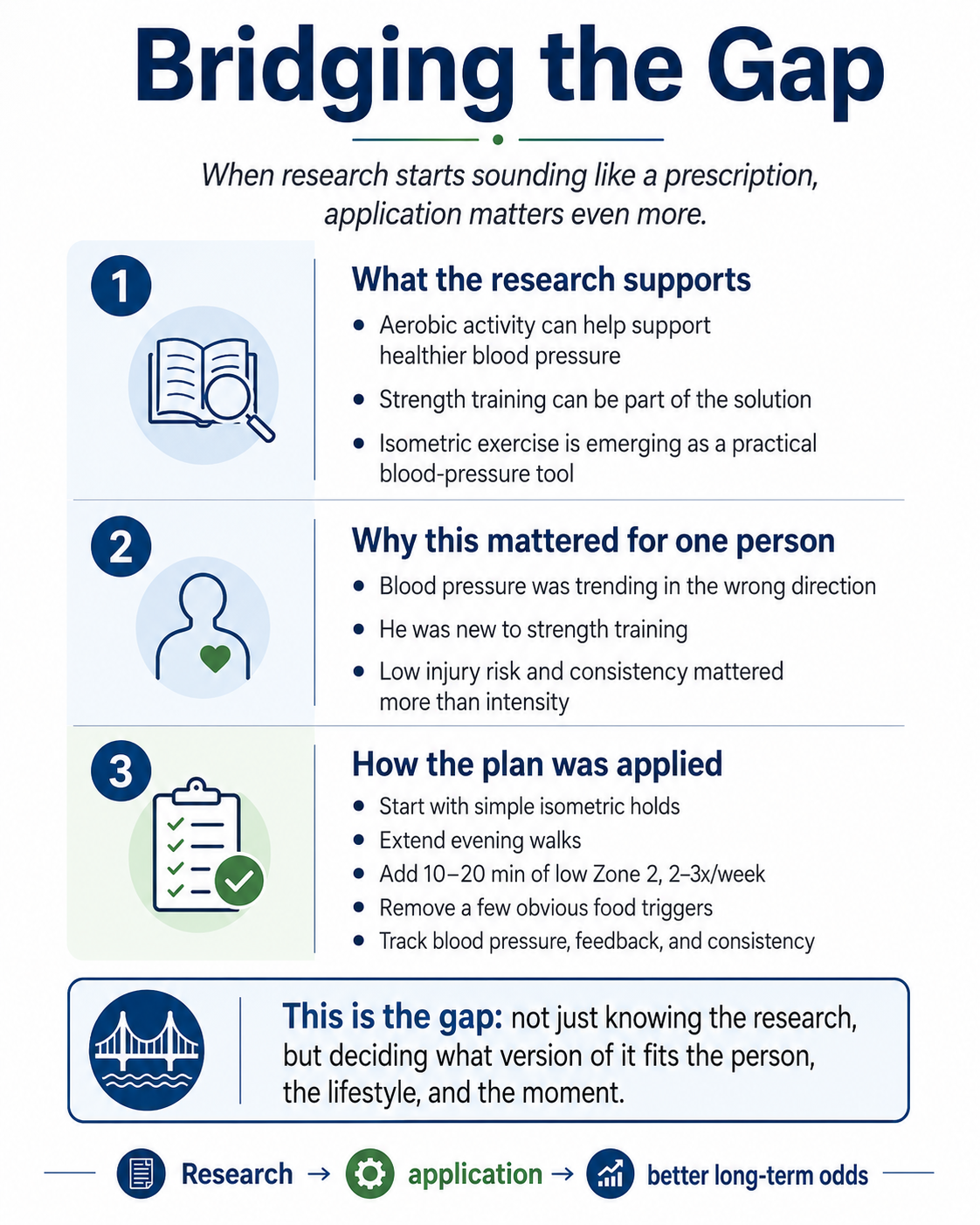
The gap is between what research says and what actually fits into a person’s life. The gap is between knowing that exercise is good for blood pressure and knowing what kind of exercise this specific person can do consistently. The gap is between knowing that strength training is important and knowing where to start when someone has very little strength training background. The gap is between knowing that nutrition matters and figuring out which small changes someone can actually repeat long enough to see if they make a difference.
A new client recently reached out to me because his blood pressure had been trending in the wrong direction. He was concerned that if it continued, blood pressure medication might eventually become part of the conversation. His question was simple: “What can I do?”
That question is where research has to become practical.
The easy answer would have been to say, “You need to exercise more, eat better, and lose weight.” That answer may not be wrong, but it is not good enough. It does not tell him where to start, what to prioritize, how much to do, what not to do, or how to fit it into his actual life. It also does not account for the fact that time was limited, he did not have a long history of structured strength or aerobic training, and jumping straight into a hard HIIT-style plan would not have been the right entry point for him.
So I went back to the research and looked at what made the most sense for his specific situation.
The American Heart Association supports regular physical activity as part of blood-pressure management and recommends at least 150 minutes of moderate-intensity aerobic activity per week for adults. Recent research has also continued to support the role of exercise in reducing resting blood pressure, and one large analysis found that isometric exercise training showed especially strong effects compared with several other exercise modes. Other recent reviews have also described isometric exercise as an effective but still underused tool for blood-pressure reduction.
But again, that is only the research side.
The application had to fit him.
Because he was newer to strength training, the plan needed to start with something simple, low-risk, and easy to repeat. That made isometric strength work a good starting point. Not because it is magic, and not because it replaces everything else, but because it gave us a way to create a meaningful strength stimulus without needing a complicated gym program or high injury risk.
Then we looked at what was already in his life. He was already walking in the evenings, so slightly extending those walks made more sense than asking him to completely rebuild his schedule. Adding 5–20 minutes of low Zone 2 walking when appropriate became another realistic layer, not as a punishment or another thing to chase, but as a controlled way to build aerobic consistency. Small dinner adjustments and better hydration became part of the plan because blood pressure is not only about training. It is also about what the body is dealing with during the rest of the day.
And then we track.
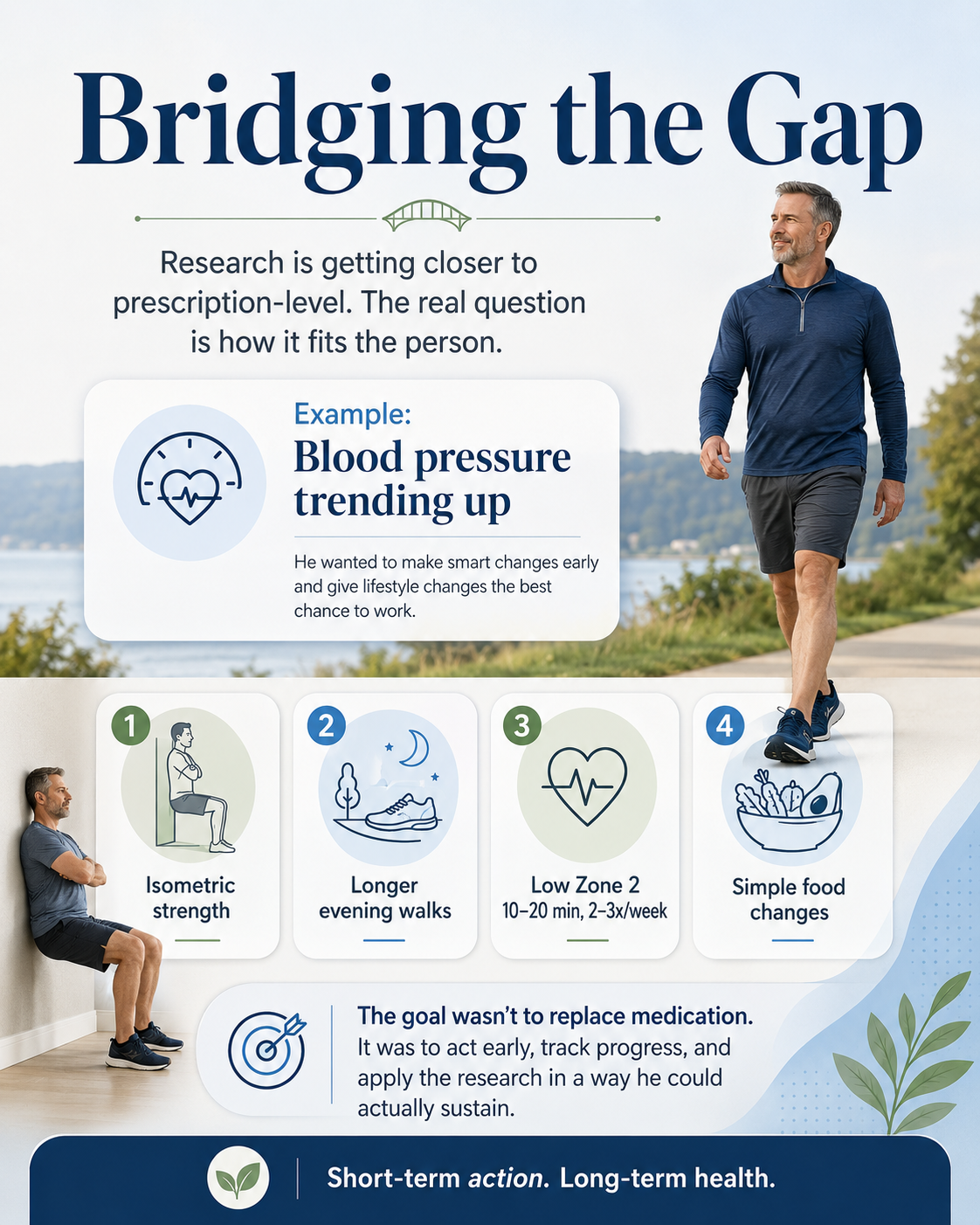
That is the part many people miss. If the goal is to influence blood pressure, we need to see what is happening to blood pressure. If the goal is long-term health, we need to know whether the plan is actually moving the person in the right direction. Not every change works the same way for every person, and that is exactly why the plan has to keep paying attention.
This is where I think health and longevity planning is going.
Not generic advice. Not one-size-fits-all programs. Not hard workouts for the sake of hard workouts. And not waiting until the problem becomes bigger before making changes.
The future is research-informed, individualized, and measurable. It is using the best available information, matching it to the person’s current ability and lifestyle, and adjusting the plan based on how they respond.
That is the gap I am interested in.
Not just what the research says.
What it means for the person in front of me.
Sources:
American Heart Association. Getting Active to Control High Blood Pressure.
British Journal of Sports Medicine. Exercise training and resting blood pressure: a large-scale pairwise and network meta-analysis of randomized controlled trials.
Sports Medicine. Isometric Exercise Training and Arterial Hypertension.