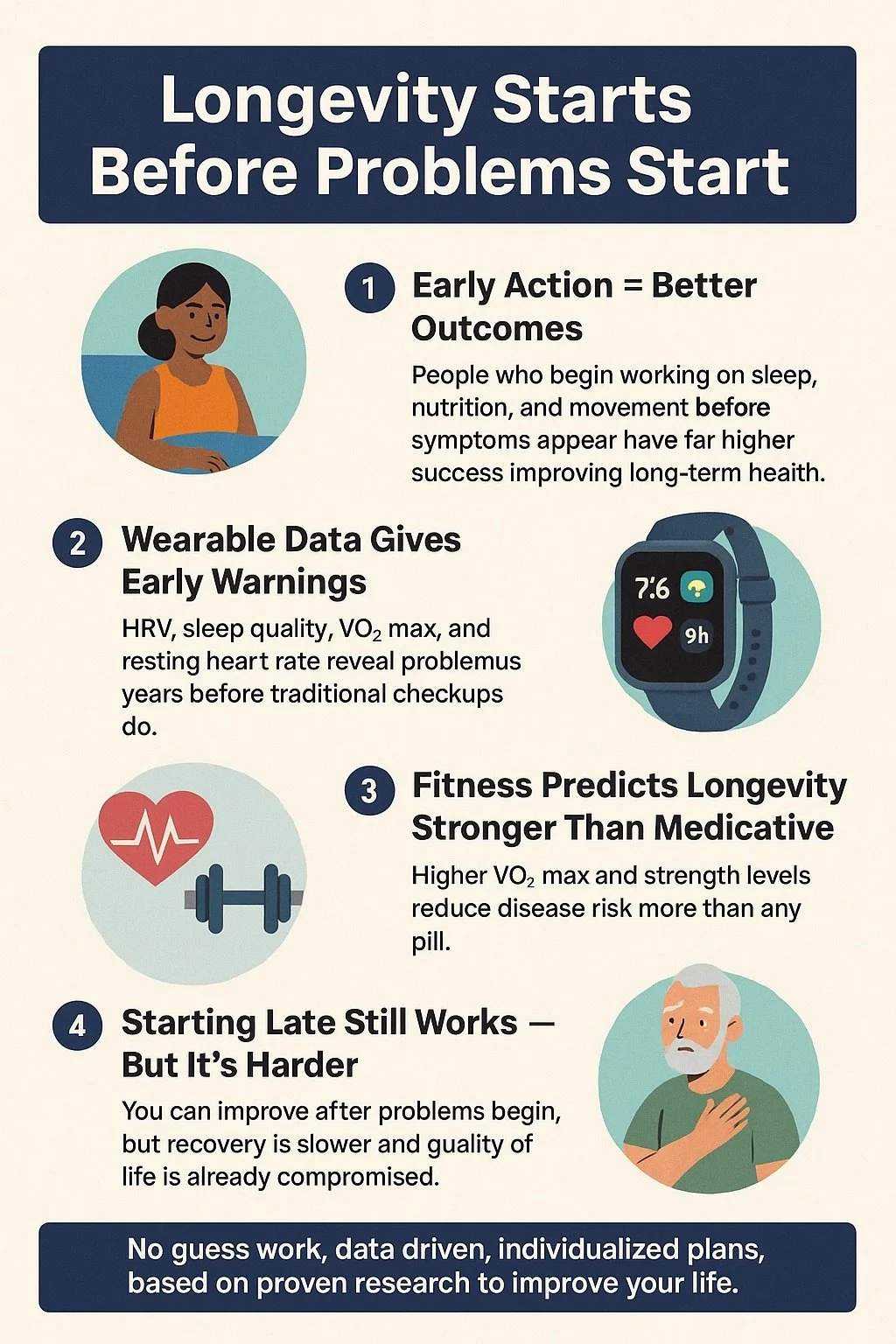
Over the last few months, I haven’t posted as much as usual.
I’ve been deep in research, building new assessments, writing individualized programs, and refining a more complete longevity system for clients. These take time — but they’ve reinforced something important:
Most people think longevity begins when something goes wrong.
A diagnosis. A symptom. A number flagged on a chart.
In reality, longevity is shaped long before any of that happens — in the daily decisions made when everything still feels “fine.”
Traditional healthcare is excellent at identifying and treating problems once they appear. Where it struggles is guiding what to do between visits, when nothing is urgent but trends are quietly forming.
That gap matters.
Health Doesn’t Decline in Appointments
It declines in the months between them.
Most health changes don’t happen suddenly. They show up gradually through patterns:
Sleep consistency drifting
Recovery taking longer
Aerobic capacity flattening
Training tolerance changing
These shifts rarely trigger alarms, but they change how the body responds to stress — physical, mental, and metabolic.
Without continuous feedback, most people don’t notice until something breaks.
Why Daily Data Changes the Game
Wearables don’t diagnose anything.
What they do provide is context.
Metrics like sleep trends, heart-rate variability, and aerobic efficiency help answer a more useful question:
“What should I do today?”
Not in theory.
In practice.
That might mean:
Adjusting training intensity
Prioritizing recovery instead of pushing
Recognizing when consistency matters more than effort
Longevity isn’t about optimizing every metric.
It’s about making fewer wrong decisions, more consistently.
The Missing Layer: Execution
Most people already know the basics:
Move regularly
Sleep well
Eat reasonably
Manage stress
Knowledge isn’t the problem.
Execution is.
What’s missing is a system that:
Interprets real-world data
Accounts for daily variability
Helps decide what actually makes sense today
That’s the layer where longevity is built — not through static plans, but through ongoing adjustment.
Before Symptoms. Before Diagnoses. Before “Fixing” Anything.
Longevity doesn’t start with disease.
It starts with awareness, feedback, and better daily decisions.
That’s the focus of Personalized Longevity Planning:
using real data to guide real actions, consistently, before problems ever appear.Longevity doesn’t start when problems show up.
“No guess work, data driven, individualized plans, based on proven research to improve your life”.