
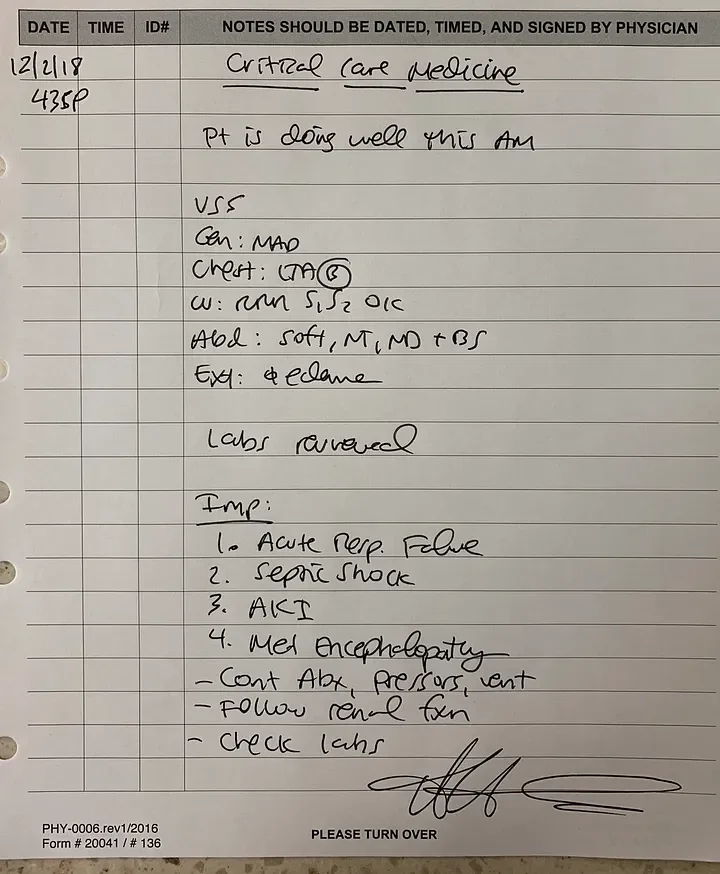
Handwritten notes from early thinking on why static health plans fail and why real-time, personalized decisions matter.
Labs capture a moment. Health, performance, and longevity are lived every day.
Most people don’t fail because they don’t care or aren’t trying.
They fail because information is acted on too slowly — or not at all — and eventually not acted on together.
Blood work, training advice, nutrition guidance, sleep recommendations, and stress management are usually delivered in isolation and without sufficient personalization.
Each input may be reasonable in theory, but it’s rarely anchored to the individual’s history, goals, constraints, injury profile, lifestyle, stress load, or current capacity. Advice is often based on population averages or generalized best practices — not on this person’s context, right now.
Without personalization, sequencing, and real-time adjustment, the system doesn’t become empowering — it becomes overwhelming.
People are left trying to reconcile:
lab ranges that don’t reflect their training background
nutrition rules that ignore their schedule, preferences, or tolerance
recovery advice disconnected from their actual stress load
training plans that assume consistency their life doesn’t allow
The result isn’t better execution.
It’s hesitation, second-guessing, and eventually paralysis.
The real problem isn’t missing data.
It’s missing decisions between check-ins.
Most health systems are built around snapshots:
a blood draw every few months
a follow-up appointment weeks later
recommendations delivered as a static list
But life doesn’t operate in snapshots.
Stress fluctuates.
Sleep changes.
Training loads accumulate.
Pain shows up.
Motivation dips.
Travel happens.
The body adapts — or breaks down — between those appointments.
Static plans assume stability.
Real humans don’t live that way.
A personal example of why context matters
In my own lab work, several markers were flagged outside standard ranges. On paper, that can look concerning.
Once those results were viewed in the context of my training history, workload, recovery patterns, and long-term trends, most of the flags made sense — not as problems to fix, but as signals to interpret.
One exception stood out: vitamin D.
That was a true actionable finding — not because it was flagged, but because it remained relevant even after context was applied.
That distinction matters.
The value of labs isn’t in the flags themselves.
It’s in knowing which signals still matter once the full picture is considered.
Where blood data does matter
Blood work can be powerful — when it’s contextualized and individualized.
Not as a standalone verdict.
Not as a generic protocol trigger.
Not as something that lives in a PDF until the next appointment.
Its value depends entirely on:
who the person is
what they’re training for
what their history looks like
what their current capacity allows
and how it informs today’s decisions
That’s the model I’m pressure-testing now: identifying where blood data genuinely shifts execution — and where it doesn’t — inside a real-time, personalized longevity plan.
This includes exploratory work using lab data from BetterWay Labs — not as a product launch, but as part of a validation phase to determine where blood data meaningfully changes decisions, and where it doesn’t.
This is not a launch.
And it’s not a promise.
It’s a deliberate validation phase.
The goal isn’t to add more tools.
It’s to remove friction, reduce overwhelm, and restore momentum — by helping people make the right decision on the right day, based on their data, their history, and their goals.
When the system adapts to the individual, people don’t just comply.
They progress.
Closing thought
Health, performance, and longevity aren’t built in perfect weeks.
They’re built by making better decisions on imperfect days — when stress is high, recovery is low, and life gets in the way.
That’s where most plans fail.
And that’s where a personalized, real-time system matters most.